
The short answer
Engine coolant is water mixed with antifreeze. It keeps the cooling system from freezing in winter, raises the temperature at which it boils in summer, and carries the inhibitors that protect the radiator, the heater core and the engine from corrosion. Use only the type named in the vehicle’s handbook, check the level twice a year with the engine cold, and change the coolant at the interval the manufacturer gives, because the inhibitors wear out long before the antifreeze does.
What the coolant does
An engine burns its fuel far hotter than its metal can stand, so the coolant has to carry the heat away continuously; at the same time the engine is designed to run warm, and “a compromise is a wall temperature of 90 °C. The viscosity of the oil is optimized for just this temperature.” Plain water would boil close to that. The antifreeze “helps prevent overheating by raising the boiling point of the coolant”, and the system is pressurised as well: “Water’s standard boiling point of 100 °C can be exceeded as the cooling system is both pressurised, and uses a mixture with antifreeze.”
In winter the same mixture “prevents the coolant from freezing in cold weather”, which matters because water expands as it freezes and would crack the block or the radiator. And all year round the coolant “provides corrosion protection by containing additives that protect the engine’s cooling system components”: the aluminium of the radiator and the heater core, the plastic of the expansion tank and the coolant flanges, and the seals between them.
Which coolant, and why types are not mixed
Antifreezes differ in their inhibitor packages, and the colours are only a rough guide. The RAC describes green (inorganic additive) coolant as the type for older vehicles built before 2000, and orange (organic acid) coolant as the type for newer vehicles with more aluminium and plastic in the system; each “shouldn’t be mixed with other types of antifreeze fluids”. The AA puts it the same way: “Make sure you use the right antifreeze – different types don’t mix well.” The rule is simple: “The owner’s manual for your vehicle will instruct you which colour antifreeze is best.”
The reason is the inhibitors, not the antifreeze itself. Mixed packages protect for a shorter time; Wikipedia notes that mixing a conventional green coolant into an organic-acid coolant “reduces the batch’s change interval to 2 years or 50,000 km (30,000 mi), but will otherwise cause no damage to the engine”. A wrong or mixed fill is therefore not an emergency, but it shortens the life of every part the coolant touches, and it is put right at the next change.
When it is changed
“Most automotive manufacturers recommend periodic complete replacement of engine coolant, to simultaneously renew corrosion inhibitors and remove accumulated contaminants.” The interval is in the service schedule of the vehicle and depends on the type: the RAC gives 36,000 miles or 3 years for green coolant and 150,000 miles or 5 years for orange and red types, and many manufacturers of recent cars specify longer intervals for their own fills. The schedule in the handbook is the one that counts.
| Sign | What it usually means |
|---|---|
| Coolant brown, cloudy or with a sludge in the tank | The inhibitors are spent and corrosion products are circulating; change the coolant and check the heater core for silting |
| Level falls again after a top-up | A leak: “If you find your coolant level repeatedly falls below the guidelines this usually indicates a leak” |
| Oily film or foam under the cap | Oil in the coolant, most often from an oil cooler or a head gasket; investigate before driving on |
| Weak cabin heat with the engine at temperature | A silted heater core or air in the system after a low level |
How the level is checked
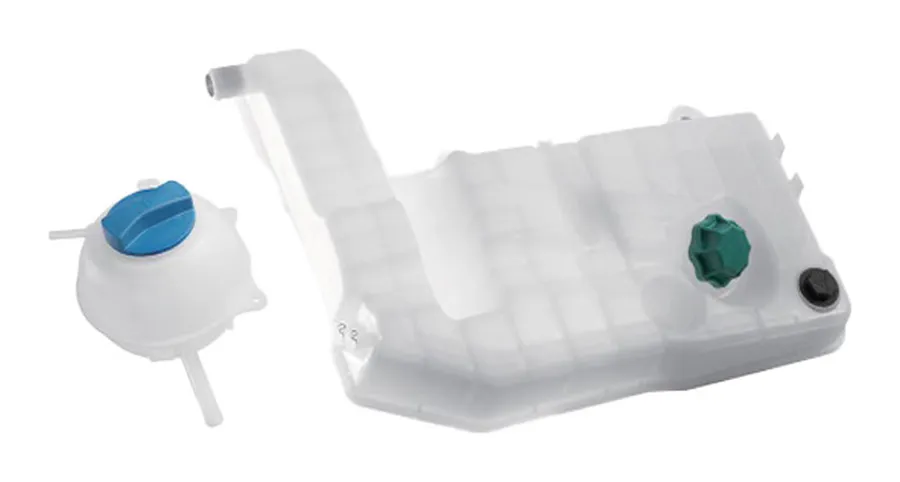
The check takes a minute and is done cold. “Always ensure the engine is cool before you open the filler cap – pressurised hot water can build up inside.” The level is read on the reservoir: “Make sure the coolant is between the min and max marks on the side of the tank.” The RAC advises that “you need to check your engine coolant at least twice a year before summer and winter, ideally”, and the AA is blunt about a falling level: “It’s not normal for the coolant level to drop. If you see that it’s dropped, get your car checked over at a garage.”
Antifreeze is a poison as well as a coolant: “Ethylene glycol, the main ingredient in some antifreeze, is poisonous to both people and other mammals.” Spills are wiped up and old coolant goes to a recycling point, not the drain.
KRONTEK supplies expansion tanks, radiator and expansion-tank caps, radiators and coolant flanges for European and Japanese passenger cars, identified by OE reference.